
Chapter-05: Part of Speech- Pronoun
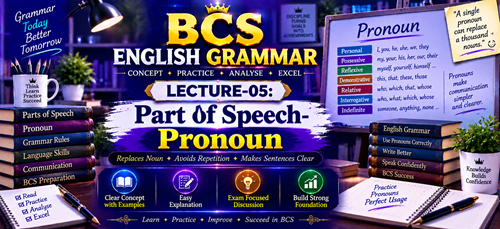
Personal • Reflexive & Emphatic • Demonstrative • Indefinite • Interrogative • Relative • Distributive • Reciprocal • Possessive Pronouns
Pronoun BCS Preliminary English Grammar-এর একটি high-yield topic। আলোচ্য প্রশ্নবিশ্লেষণ অনুযায়ী ৪১তম, ৩৮তম, ২২তম, ১৫তম ও ১২তম BCS-এ Pronoun থেকে সরাসরি প্রশ্ন এসেছে। প্রশ্নের ধরন ছিল—pronoun identification, distributive pronoun, relative pronoun, relative clause, possessive/subject-object form, who–whom–whose, one/either/neither, demonstrative pronoun ইত্যাদি। তাই এই topic পড়ার সবচেয়ে কার্যকর পদ্ধতি হলো definition → classification → personal pronoun case → reflexive → demonstrative → indefinite → interrogative/relative distinction → distributive → reciprocal → agreement এই ধারায় পড়া।
| Priority | Topic | BCS Focus |
|---|---|---|
| ★★★ | Pronoun Identification | that, one, either, none |
| ★★★ | Personal Pronoun Case | I/me, we/us, he/him, they/them |
| ★★★ | Relative Pronoun | who, whom, whose, which, that |
| ★★★ | Distributive Pronoun | each, either, neither |
| ★★★ | Subject–Object Form | verb/preposition/let-এর পরে object form |
| ★★★ | Reflexive Pronoun | myself, himself, themselves |
| ★★☆ | Indefinite Pronoun | one, anyone, everyone, none |
| ★★☆ | Demonstrative Pronoun | this, that, these, those |
| ★★☆ | Reciprocal Pronoun | each other, one another |
| ★★☆ | Possessive Forms | my/mine, our/ours, their/theirs |
১. Pronoun — সঠিক সংজ্ঞা
Pronoun হলো এমন word যা noun বা noun phrase-এর পরিবর্তে ব্যবহৃত হয় অথবা এমন ব্যক্তি/বস্তু/ধারণাকে refer করে যার identity context থেকে বোঝা যায়। এই কারণে Pronoun-কে traditional grammar-এ Substituting Word বলা হয়। যেমন—Rahim is a student. He reads regularly. এখানে দ্বিতীয় বাক্যে Rahim পুনরাবৃত্তি না করে he ব্যবহৃত হয়েছে। আলোচ্য lecture-এও Pronoun-কে noun-এর পরিবর্তে ব্যবহৃত substituting word হিসেবে সংজ্ঞায়িত করা হয়েছে। Merriam-Webster ও Cambridge-ও pronoun-কে noun/noun phrase-এর substitute বা contextually understood reference হিসেবে ব্যাখ্যা করে।
🌳 Noun → Pronoun Relationship
              NOUN / NOUN PHRASE
                     │
                     ▼
            repeated reference?
                     │
                     ▼
                  PRONOUN
                     │
      ┌──────────────┼──────────────┐
      │              │              │
    Rahim          the book       the boys
      │              │              │
      ▼              ▼              ▼
     he              it            they
২. 🔥 ৪১তম BCS — Direct Question
‘Who’s that?’—এখানে ‘that’ হলো—
ক. Pronoun
খ. Conjunction
গ. Adjective
ঘ. Adverb
✅ সঠিক উত্তর: Pronoun
কারণ: that এখানে কোনো noun-এর আগে বসেনি; এটি নিজেই “ও ব্যক্তি/বস্তুটি” বোঝাচ্ছে, তাই Demonstrative Pronoun। কিন্তু that boy বললে that determiner/demonstrative adjective হিসেবে noun-কে modify করত।
🎯 মনে রাখুন: That is mine → Pronoun | That book is mine → Determiner
৩. “One” কখন Pronoun?
Among the students, the best one is a boy. এখানে one পূর্বে উল্লেখিত noun-class-এর একটি member-এর জায়গায় বসেছে; তাই Pronoun।
Rule
one + no following noun → pronoun
one book → numeral/determiner
এই distinction objective প্রশ্নে খুব গুরুত্বপূর্ণ।
৪. Pronoun-এর প্রধান শ্রেণিবিভাগ
আলোচ্য lecture-এ Pronoun-কে প্রধানত ৯ প্রকার দেখানো হয়েছে—Personal, Reflexive & Emphatic, Indefinite, Relative, Demonstrative, Interrogative, Distributive, Reciprocal এবং Possessive Pronoun।
🧩 Classification Diagram
                              PRONOUN
                                 │
 ┌────────────┬────────────┬─────┼──────┬─────────────┬────────────┐
 │            │            │            │             │            │
Personal   Reflexive    Demonstrative  Relative   Interrogative  Indefinite
 │            │            │            │             │            │
I, we      myself      this, that      who         who          anyone
he, they   himself     these, those    which       what         everyone
                                         │
                    ┌────────────────────┼────────────────────┐
                    │                    │                    │
              Distributive          Reciprocal           Possessive
              each/either          each other            mine/ours
              neither              one another           theirs
Cambridge-এর classification-ও personal, possessive, reflexive, interrogative, demonstrative, indefinite, reciprocal ও relative pronoun আলাদা category হিসেবে দেখায়।
৫. Personal Pronoun
Personal Pronoun speaker, listener এবং third person/thing-এর reference দেয় এবং person, number ও case অনুযায়ী form পরিবর্তন করতে পারে। Cambridge অনুযায়ী personal pronoun-এর subject ও object form আলাদা হতে পারে; যেমন I/me, he/him, she/her, we/us, they/them।
📊 Personal Pronoun Master Table
| Person | Number | Subjective | Objective | Possessive Determiner | Possessive Pronoun |
|---|---|---|---|---|---|
| 1st | Singular | I | me | my | mine |
| 1st | Plural | we | us | our | ours |
| 2nd | Singular/Plural | you | you | your | yours |
| 3rd | Singular Male | he | him | his | his |
| 3rd | Singular Female | she | her | her | hers |
| 3rd | Singular Neuter | it | it | its | — |
| 3rd | Plural | they | them | their | theirs |
Lecture-এ archaic thou/thee/thy/thine-ও দেখানো হয়েছে।
৬. Subjective বনাম Objective Case
Subject হিসেবে pronoun হলে I, we, he, she, they ব্যবহৃত হয়; verb বা preposition-এর object হলে me, us, him, her, them ব্যবহৃত হয়।
Compare
He called me.
They invited us.
She spoke to him.
Between you and me...
Cambridge-ও personal pronoun-এর subject/object distinction একইভাবে দেখায়।
৭. 231 Rule — পরীক্ষামুখী Convention
Lecture-এ positive/neutral sentence-এ বিভিন্ন person একসঙ্গে subject হলে traditional পরীক্ষামুখী order দেওয়া হয়েছে:
2nd Person → 3rd Person → 1st Person = 231
Example
✅ You, he and I were present.
✅ You, Rahim and I have passed.
🧩 231 Memory Model
POSITIVE / NEUTRAL COMBINATION

        YOU       HE/SHE/THEY       I/WE
         │             │             │
        2nd    →       3rd    →      1st
                      = 231
গুরুত্বপূর্ণ Modern Note
231 কোনো universal modern English grammar law নয়; এটি South Asian competitive grammar-এ প্রচলিত politeness/order convention। Natural English-এ coordination-এর order context/style অনুযায়ী পরিবর্তিত হতে পারে; তবে BCS/competitive MCQ-তে source-এর pattern অনুসরণ করাই নিরাপদ।
৮. 123 Rule — দোষ/অপরাধ স্বীকার
Lecture-এর traditional rule অনুযায়ী blame, fault বা guilt স্বীকারের ক্ষেত্রে order:
1st → 2nd → 3rd = 123
✅ I, you and he are to blame.
🧠 Memory
Good/neutral → 231
Blame/fault → 123
আবারও মনে রাখবে—এটি পরীক্ষামুখী prescriptive convention, universal syntax rule নয়।
৯. 🔥 Correct Sentence Pattern
Choose the correct sentence:
✅ You, he and I were present in the class.
কারণ: source-এর 231 convention অনুসারে 2nd → 3rd → 1st, এবং তিনটি subject একত্রে plural অর্থ দেয় বলে were।
১০. Verb-এর আগে Pronoun → Subject Form
Verb-এর subject হিসেবে pronoun থাকলে subjective/nominative form ব্যবহার করা হয়:
✅ He, not I, is responsible.
❌ He, not me, is responsible — formal exam grammar-এ subject slot-এ I expected।
Lecture-এ একই rule ও সরকারি নিয়োগ পরীক্ষার question দেওয়া হয়েছে।
১১. Verb-এর পরে Object Form
Ordinary transitive verb-এর object হলে:
call me, help us, invite him, see her, punish them
সম্ভাব্য প্রশ্ন
They called ___ on the telephone.
✅ us
কারণ called verb-এর object প্রয়োজন এবং us objective form।
১২. Let-এর পরে Objective Case
Let verb; তাই এর পরে pronoun হলে objective form ব্যবহৃত হয়:
Let me go.
Let him speak.
Let her and you go.
Lecture-এ multiple pronoun-এর ক্ষেত্রে source-এর 231 ordering-ও প্রয়োগ করা হয়েছে।
Direct Pattern
Let ___ go there.
✅ her and you — source-based ordering অনুযায়ী।
১৩. Preposition-এর পরে Object Form
Preposition-এর পরে objective form:
to me, for him, with her, between you and me, among us
সম্ভাব্য প্রশ্ন
Between ___, this is the greatest book I’ve ever read.
✅ you and me
কারণ between preposition; এর পরে objective forms হয়।
🎯 Famous Trap
❌ between you and I
✅ between you and me
১৪. Be Verb-এর পরে I নাকি Me?
Lecture-এর traditional/formal rule:
It is I who am to blame.
It was we who had left.
Modern English Nuance
Formal prescriptive grammar-এ subject complement হিসেবে It is I শেখানো হয়; কিন্তু modern conversational English-এ It’s me / It was us অত্যন্ত স্বাভাবিক ও standard informal usage। তাই BCS-style formal MCQ-তে It is I, কিন্তু everyday English-এ It’s me গ্রহণযোগ্য।
১৫. Relative Clause Agreement after “It is I/You/She who…”
Relative pronoun-এর পরে verb তার antecedent-এর person/number অনুসরণ করতে পারে:
It is I who am to blame.
It is you who are to blame.
It is she who has done the work.
Lecture-এ এই ruleটি স্পষ্টভাবে দেওয়া আছে।
১৬. Possessive Determiner বনাম Possessive Pronoun
Possessive Determiner
my, your, his, her, its, our, their → noun-এর আগে বসে।
my book, their house
Possessive Pronoun
mine, yours, his, hers, ours, theirs → noun ছাড়া নিজেই দাঁড়ায়।
This book is mine.
Cambridge-ও possessive pronoun-কে mine, yours, ours, hers ইত্যাদি হিসেবে দেখায়।
১৭. Its বনাম It’s — অত্যন্ত গুরুত্বপূর্ণ
its = possessive
it’s = it is / it has
✅ The dog wagged its tail.
✅ It’s raining.
Lecture-এও noun-এর আগে possessive adjective এবং its ≠ it’s distinction দেওয়া হয়েছে।
১৮. Thee / Thou / Thy / Thine — Classical Forms
| Modern | Archaic |
|---|---|
| you — subject | thou |
| you — object | thee |
| your | thy |
| yours | thine |
সম্ভাব্য প্রশ্ন
“Youth, I do adore thee.” — ‘thee’ অর্থ—
✅ you
১৯. Gerund-এর আগে Possessive Form
Traditional formal grammar-এ gerund-এর logical subject possessive form নিতে পারে:
I insist on your coming.
They objected to his smoking.
Lecture-এ pattern:
Preposition + Possessive Adjective + Gerund
এবং question: When friends insist on ___ expensive gifts... → their accepting।
Modern Usage Note
Contemporary English-এ object form-ও অনেক ক্ষেত্রে natural: I don’t mind him coming, বিশেষ করে informal speech। Formal competitive grammar-এ possessive form safer।
২০. Reflexive Pronoun — সংজ্ঞা
যখন sentence-এর subject ও object একই ব্যক্তি/বস্তু, তখন object position-এ reflexive pronoun ব্যবহৃত হয়। Reflexive pronoun সাধারণত -self/-selves দিয়ে শেষ হয়—myself, yourself, himself, herself, itself, ourselves, yourselves, themselves। Lecture-এও এই formation এবং subject-object identity-কে মূল সংজ্ঞা হিসেবে দেওয়া হয়েছে। Cambridge ও British Council একই rule দেয়।
📊 Reflexive Table
| Subject | Reflexive |
|---|---|
| I | myself |
| you | yourself/yourselves |
| he | himself |
| she | herself |
| it | itself |
| we | ourselves |
| they | themselves |
| one | oneself |
২১. 🔥 Reflexive Direct Question
“He killed himself.” এখানে ‘himself’ হলো—
✅ Reflexive Pronoun
কারণ: subject he এবং object himself একই person-কে refer করছে।
২২. Reflexive vs Emphatic Pronoun
একই form myself, himself, herself কখনো reflexive, কখনো emphatic হতে পারে।
Reflexive
He hurt himself.
→ object দরকার; himself = same person as subject।
Emphatic
He himself did the work.
I did it myself.
→ শুধু emphasis; pronoun বাদ দিলেও core sentence grammatical থাকে।
British Council reflexive forms-এর emphatic use-ও দেখায়।
🧩 Test
He hurt himself.
      │
remove "himself" → He hurt... ❌ incomplete
= REFLEXIVE

He himself came.
   │
remove "himself" → He came. ✅
= EMPHATIC
২৩. By + Reflexive = Alone
by myself, by yourself, by themselves সাধারণত “একা/নিজে” অর্থে ব্যবহৃত হয়।
She lives by herself.
He completed the task by himself.
British Council এই structure-কে explicitly “alone” অর্থে ব্যাখ্যা করে।
২৪. কিছু Verb + Reflexive
Lecture-এ absent, avail, enjoy, pride, exert ইত্যাদির সঙ্গে reflexive usage শেখানো হয়েছে। যেমন:
He absented himself from the meeting.
He prides himself on his knowledge.
Modern Nuance
সব verb-এর সঙ্গে reflexive বাধ্যতামূলক নয়। যেমন enjoy yourself বললে “ভালো সময় কাটাও”; কিন্তু I enjoyed the film-এ reflexive লাগে না। Context দেখতে হবে।
২৫. Demonstrative Pronoun
যে pronoun কোনো ব্যক্তি/বস্তুকে near/far এবং singular/plural reference দিয়ে নির্দেশ করে, তাকে Demonstrative Pronoun বলে। Core forms:
this, that, these, those
Lecture-এ it, so, such, the sameও broader demonstrative-type reference হিসেবে উল্লেখ আছে।
Core Table
| Near | Far |
|---|---|
| this | that |
| these | those |
সম্ভাব্য প্রশ্ন
Which is a demonstrative pronoun?
✅ those
২৬. Demonstrative Pronoun vs Demonstrative Determiner
This is good. → Pronoun
This book is good. → Determiner
Those are mine. → Pronoun
Those books are mine. → Determiner
Cambridge-এর pronoun classification-এ this, that, these, those demonstrative pronoun হিসেবে আছে; noun-এর আগে থাকলে determiner function নেয়।
২৭. That of / Those of — Comparison
একই noun বারবার repeat না করতে comparison-এ:
that of → singular/uncountable reference
those of → plural countable reference
Example
The climate of Bangladesh is different from that of Canada.
The fingerprints of one person are different from those of another.
Lecture-এ এই replacement rule দেওয়া হয়েছে।
২৮. Indefinite Pronoun
যে pronoun কোনো অনির্দিষ্ট ব্যক্তি, বস্তু বা পরিমাণ বোঝায় তাকে Indefinite Pronoun বলে। Lecture-এ examples হিসেবে one, none, any, anyone, anybody, someone, somebody, everyone, everybody, another, others, most, everything, something, nothing, many, all, few, little, much, more ইত্যাদি আছে। Merriam-Webster-ও everybody, either, none, something ইত্যাদিকে indefinite pronoun বলে।
সম্ভাব্য প্রশ্ন
Which one is the indefinite pronoun?
✅ Anybody
২৯. “None” — Indefinite Pronoun
None but Allah can help us. এখানে none = Indefinite Pronoun।
৩০. One of + Plural Noun + Singular Verb
Structure:
One of + plural noun/pronoun + singular verb
✅ One of my uncles is a lawyer.
✅ One of the problems is easy.
Lecture-এ এই ruleটি স্পষ্টভাবে দেওয়া হয়েছে।
🧩 Agreement Formula
ONE OF + PLURAL NOUN + SINGULAR VERB

one of the boys      is
one of my friends    has
one of the books     was
৩১. “One” subject হলে One’s
Generic one subject হলে formal possessive সাধারণত one’s:
One should do one’s duty.
The more hemoglobin one has, the more oxygen is carried to one’s cells.
Lecture-এ একই rule ও question আছে। Cambridge-ও generic one এবং possessive one’s ব্যবহারের কথা বলে।
Modern Note
Modern everyday English-এ generic you বেশি common: You should do your duty.
৩২. Interrogative Pronoun
যে pronoun দিয়ে প্রশ্ন করা হয় তাকে Interrogative Pronoun বলে: who, whom, whose, which, what। Lecture-এ এগুলোকে প্রশ্নবোধক pronoun হিসেবে চিহ্নিত করা হয়েছে।
Examples
Who came?
Whom did you meet?
Which do you prefer?
What happened?
Direct Question
“Whom did you meet yesterday?”—‘whom’ হলো—
✅ Interrogative Pronoun
৩৩. Who বনাম Whom
Who সাধারণত subject; whom formal objective form।
Who called you?
Whom did you call?
To whom did you speak?
British Council relative pronoun table-এও who = subject, who/whom = object, whose = possessive দেখায়।
Quick Test
he fits → who
him fits → whom
Who called? → He called.
Whom did you call? → I called him.
৩৪. Relative Pronoun — সংজ্ঞা
Relative Pronoun antecedent-এর সঙ্গে একটি subordinate/relative clause যুক্ত করে এবং সেই antecedent-এর বিষয়ে অতিরিক্ত বা identifying information দেয়। Core forms: who, whom, whose, which, that। Lecture-এ relative pronoun-কে clauses-এর মধ্যে সম্পর্ক স্থাপনকারী pronoun হিসেবে দেখানো হয়েছে। British Council-ও relative pronoun-কে relative clause introduce করার word হিসেবে সংজ্ঞায়িত করে।
🌳 Relative Pronoun Selection
                    ANTECEDENT
                        │
             ┌──────────┴──────────┐
             │                     │
           PERSON              THING/ANIMAL
             │                     │
       ┌─────┼─────┐          which / that
       │     │     │
      who   whom  whose
    subject object possession
৩৫. Interrogative বনাম Relative Pronoun
একই who/which/what/whose function অনুযায়ী category বদলাতে পারে।
| Interrogative | Relative |
|---|---|
| Who came? | The man who came... |
| Which do you want? | The book which I bought... |
| Whose is this? | The boy whose bag was lost... |
অতএব word দেখেই answer নয়; sentence function দেখতে হবে।
৩৬. 🔥 ২২তম BCS — Direct Question
The children studied in a classroom ____ windows were never opened.
ক. that
খ. which
গ. where
ঘ. whose
✅ সঠিক উত্তর: Whose
কারণ: blank-এর পরে windows noun আছে এবং classroom-এর সঙ্গে possession/connection বোঝাচ্ছে—“যে classroom-এর windows”; তাই whose।
Extra Important
Modern English-এ whose শুধু person-এর জন্য নয়; thing/institution-এর possessive relation-ও বোঝাতে পারে—যেমন a house whose roof was damaged। British Council-এর relative table-তেও whose possessive form হিসেবে person/thing relative system-এর অংশ।
৩৭. 🔥 ১৫তম BCS — Direct Question
My uncle has three sons, ____ work in the same office.
ক. All of them
খ. Who all
গ. They all
ঘ. All of whom
✅ সঠিক উত্তর: All of whom
কারণ: comma-এর পরে একটি non-finite fragment নয়, নতুন relative clause প্রয়োজন; whom antecedent sons-এর সঙ্গে relation তৈরি করছে এবং all of whom একটি non-defining relative structure।
৩৮. 🔥 ১২তম BCS — Who, Which, What
আলোচ্য প্রশ্নে:
Who, Which, What are—
✅ Relative Pronoun
⚠️ কিন্তু Conceptual Nuance
who, which, what সবসময় Relative Pronoun নয়; question শুরু করলে Interrogative Pronoun-ও হতে পারে। যেমন Who came? = interrogative। BCS questionটি classification/context অনুযায়ী Relative Pronoun answer গ্রহণ করেছে; তাই function-based identification করতে হবে।
৩৯. Relative Pronoun + Verb Agreement
Relative pronoun-এর পরে verb সাধারণত antecedent-এর number/person অনুসরণ করে:
I who am...
You who are...
She who has...
Lecture-এ examples: It is you who are to blame; It is she who has done the work.
৪০. Who / Which / That — Subject Function
যদি blank-এর পরে সরাসরি verb থাকে এবং antecedent person হয়, who সাধারণত subject relative pronoun:
The teachers who challenge us...
যদি antecedent thing হয়, which/that:
The books that contain examples...
Lecture-এ এই structural test দেওয়া হয়েছে।
৪১. Whoever
যেখানে specific antecedent নেই এবং অর্থ “যে-ই/যে ব্যক্তি”:
Give the clothes to whoever needs them.
Lecture-এর rule: gap-এর পরে verb এবং আগে person antecedent না থাকলে whoever।
Whoever vs Whomever
whoever clause-এর subject
whomever clause-এর object — formal usage
Give it to whoever asks. → whoever = asks-এর subject
Give it to whomever you choose. → whomever = choose-এর object
৪২. Whose — Possession/Connection
যদি noun-এর possession/connection বোঝায়:
The teacher whose students performed well...
Lecture-এ একই rule ও question দেওয়া হয়েছে।
৪৩. Relative Pronoun — Defining vs Non-defining
এটি PDF-এর বাইরের গুরুত্বপূর্ণ related data।
Defining Relative Clause
কোন person/thing বোঝানো হচ্ছে তা identify করে:
The student who came late apologized.
এখানে clause বাদ দিলে reference incomplete হতে পারে।
Non-defining Relative Clause
শুধু extra information:
Rahim, who lives in Dhaka, is my friend.
এখানে comma ব্যবহৃত হয় এবং that সাধারণত non-defining clause-এ ব্যবহার করা হয় না। British Council relative clauses-কে defining ও non-defining—এই দুই প্রধান ধরনে ভাগ করে।
৪৪. Relative Pronoun Omission
Defining relative clause-এ relative pronoun object হলে অনেক সময় বাদ দেওয়া যায়:
The book (that) I bought is expensive.
কিন্তু subject হলে বাদ যায় না:
❌ The man came yesterday is my uncle.
✅ The man who came yesterday is my uncle.
British Council object relative pronoun omission-এর rule দেয়।
৪৫. Distributive Pronoun
যে pronoun group-এর members-কে একজন/একটি করে আলাদাভাবে নির্দেশ করে, তাকে Distributive Pronoun বলে। Traditional examples:
each, either, neither
Lecture-এ either = দুইটির যেকোনো একটি/প্রত্যেকটির মধ্যে একটি, neither = দুইটির কোনোটিই নয় হিসেবে ব্যাখ্যা করা হয়েছে।
৪৬. 🔥 ৩৮তম BCS — Direct Question
Which one of the following words is an example of a distributive pronoun?
ক. such
খ. either
গ. that
ঘ. any
✅ সঠিক উত্তর: Either
কারণ: either দুইটি alternative-এর একটি বা অন্যটি বোঝায়; traditional classification-এ এটি Distributive Pronoun।
৪৭. Either বনাম Neither
Either → two alternatives-এর যেকোনো একটি
Neither → দুইটির কোনোটিই নয়
Either of the two roads is suitable.
Neither of the two roads is suitable.
Cambridge-ও neitherকে two people/things-এর “not either” অর্থে এবং neither of + plural noun/pronoun structure-এ ব্যবহার দেখায়।
৪৮. Either শুধু “দুই” — Any তিন বা তার বেশি
Traditional competitive grammar-এ:
Either of the two...
Any of the three/four/many...
Question
Which sentence is correct?
✅ Any of the three pens will do.
কারণ three থাকায় either নয়, any। Lecture-এর page 33-এর question-এও এই distinction শেখানো হয়েছে।
৪৯. Each/Either/Neither of + Plural Noun + Singular Verb
Formal exam pattern:
Each of the boys is...
Either of the roads leads...
Neither of the buses goes...
Lecture-এ ruleটি explicitly দেওয়া আছে। Cambridge-ও formal style-এ each of / neither of + plural noun → singular verb দেখায়।
Direct Question
Neither of the roads ___ to the railway station.
✅ leads
৫০. Modern Agreement with Each/Everyone/Neither
Formal exam grammar singular verb রাখে:
Everyone is ready.
Each of them has arrived.
কিন্তু pronoun reference-এ modern English-এ singular they/their খুব common:
Everyone has their own opinion.
Each student should bring their ID.
Cambridge স্পষ্টভাবে everyone/someone/anyone এর পরে they/their/them-এর gender-neutral reference এবং singular verb usage দুটোই স্বীকৃত বলে।
BCS Strategy
Verb → singular
Possessive → পুরনো exam-এ his/her; modern English-এ their accepted/common
৫১. Reciprocal Pronoun
যখন দুই বা ততোধিক ব্যক্তি একে অন্যের ওপর একই action করে, তখন each other / one another Reciprocal Pronoun হিসেবে ব্যবহৃত হয়। Lecture-এ traditional rule হিসেবে দুইজন → each other; দুইয়ের বেশি → one another দেওয়া হয়েছে।
Example
Rahim and Karim help each other.
The players congratulated one another.
সম্ভাব্য প্রশ্ন
They fought with one another. ‘One another’ is—
✅ Reciprocal Pronoun
৫২. Each Other বনাম One Another — Modern Nuance
Traditional exam rule:
2 → each other
More than 2 → one another
কিন্তু modern standard English-এ এই distinction কঠোর নয়; each other ও one another প্রায় interchangeably ব্যবহৃত হয়। Cambridge ও British Council reciprocal pronoun হিসেবে দুটিকেই পাশাপাশি দেখায়।
অতএব BCS/competitive exam → traditional distinction, কিন্তু real-world English → দুটোই অনেক ক্ষেত্রে acceptable।
৫৩. Reciprocal বনাম Reflexive
এটি খুব গুরুত্বপূর্ণ।
They looked at themselves.
→ প্রত্যেকে নিজের দিকে তাকিয়েছে → Reflexive
They looked at each other.
→ একজন অন্যজনের দিকে তাকিয়েছে → Reciprocal
British Council এই contrast সরাসরি শেখায়।
🧩 Visual Model
REFLEXIVE
A ───► A
B ───► B

RECIPROCAL
A ───► B
B ───► A
৫৪. Possessive Pronoun
mine, yours, his, hers, ours, theirs noun-এর possession/ownership বোঝায় এবং noun ছাড়াই noun phrase-এর head হিসেবে দাঁড়ায়।
This book is mine.
That car is theirs.
Possessive Determiner vs Pronoun
| Before Noun | Independent |
|---|---|
| my | mine |
| your | yours |
| her | hers |
| our | ours |
| their | theirs |
Cambridge-এর pronoun classification-এ possessive pronoun হিসেবে mine, ours, hers ইত্যাদি রয়েছে।
৫৫. Pronoun Antecedent — গুরুত্বপূর্ণ Related Concept
Antecedent হলো যে noun/noun phrase-কে pronoun refer করে।
Rahim lost his book.
Rahim = antecedent; his = pronoun-related possessive reference।
Relative pronoun-এর ক্ষেত্রে antecedent বিশেষভাবে গুরুত্বপূর্ণ:
The boy who came...
boy = antecedent; who = relative pronoun।
৫৬. Pronoun-Antecedent Agreement
Traditional rule অনুযায়ী pronoun antecedent-এর number/person/gender-এর সঙ্গে compatible হতে হবে।
The boys finished their work.
The girl finished her work.
কিন্তু unknown gender-এর singular human antecedent-এর জন্য contemporary English-এ singular they widely accepted:
Someone left their phone.
Cambridge generic someone, anyone, everyone এর পরে they/them/their ব্যবহারের উদাহরণ দেয়।
৫৭. “Everyone” — Singular Verb কিন্তু Singular They
Everyone is ready. ✅
Everyone are ready. ❌ formal standard
কিন্তু:
Everyone should bring their ID. ✅ modern standard
Cambridge জানায় everyone/everybody singular verb নেয়, তবে back-reference-এ they/their informal এবং modern usage-এ common।
৫৮. Pronoun vs Determiner — High-Yield Trap
একই word কখনো pronoun, কখনো determiner:
This is good. → pronoun
This book is good. → determiner
Which do you want? → pronoun
Which book do you want? → determiner
Some arrived. → pronoun
Some students arrived. → determiner
Cambridge উল্লেখ করে কিছু determiner noun ছাড়া ব্যবহৃত হলে pronoun হিসেবে কাজ করে।
৫৯. Who / Which / What — Function Chart
| Word | Interrogative Use | Relative Use |
|---|---|---|
| who | Who came? | the man who came |
| whom | Whom did you call? | the man whom I called |
| whose | Whose is this? | the man whose car... |
| which | Which do you want? | the book which I bought |
| what | What happened? | traditional/free-relative contexts: what I need |
Important Precision
Standard relative clause-এ what সাধারণত explicit antecedent-এর পরে আসে না:
❌ the thing what I need
✅ the thing that I need
✅ what I need
৬০. Pronoun Case — Master Chart
                    PRONOUN CASE
                         │
        ┌────────────────┼────────────────┐
        │                │                │
     SUBJECT           OBJECT          POSSESSIVE
        │                │                │
       I                me              my/mine
      we                us              our/ours
      he                him             his
      she               her             her/hers
      they              them            their/theirs
Exam Formula
Before finite verb as subject → subjective
After transitive verb → objective
After preposition → objective
Before noun → possessive determiner
Without noun → possessive pronoun
৬১. 🔥 BCS Direct Question Master Table
| BCS | Question | Correct Answer |
|---|---|---|
| ৪১তম | “Who’s that?” — that | ✅ Pronoun |
| ৩৮তম | example of distributive pronoun | ✅ Either |
| ২২তম | classroom ___ windows | ✅ Whose |
| ১৫তম | three sons, ___ work... | ✅ All of whom |
| ১২তম | Who, Which, What are— | ✅ Relative Pronoun — source question |
৬২. ⚠️ High-Yield Pronoun Traps
| ভুল/Confusion | Correct |
|---|---|
| between you and I | between you and me |
| let he go | let him go |
| they called we | they called us |
| its = it is | ❌ its = possessive |
| it’s = possessive | ❌ it’s = it is/has |
| one of the boy | one of the boys |
| one of the boys are | formal exam → is |
| either of three | traditional rule → any of three |
| neither of two roads lead | formal → leads |
| everyone are | everyone is |
| everyone has his only | modern English → their also accepted |
| who = always relative | ❌ context-dependent |
| that = always pronoun | ❌ can be determiner/relative pronoun |
| each other = reflexive | ❌ reciprocal |
| themselves = reciprocal | ❌ reflexive |
| classroom which windows | ❌ whose windows |
৬৩. Pronoun Identification Flowchart
                       WORD
                         │
           noun-এর বদলে/reference দিচ্ছে?
                         │
                        YES
                         │
                       PRONOUN
                         │
      ┌──────────────────┼─────────────────────┐
      │                  │                     │
  Person reference?   Question?           Joins relative clause?
      │                  │                     │
  Personal            Interrogative          Relative
      │
same subject-object?
      │
  Reflexive
      │
points to something?
      │
 Demonstrative
      │
unspecified person?
      │
 Indefinite
      │
one-by-one distribution?
      │
 Distributive
      │
mutual action?
      │
 Reciprocal
৬৪. Modern Grammar vs Competitive Exam — গুরুত্বপূর্ণ পার্থক্য
| Topic | Competitive/Traditional Rule | Modern Standard Usage |
|---|---|---|
| Person order | 231 / 123 | flexible; style/context-based |
| Be + pronoun | It is I | It’s me common/standard informal |
| Everyone possessive | his/her | their widely accepted |
| Each other/one another | 2 vs >2 | mostly interchangeable |
| Gerund subject | possessive preferred | object form also common informally |
| Neither of + verb | singular | plural heard in informal speech |
| Singular they | older books কম ব্যবহার | widely established |
এই distinction জানা জরুরি, কারণ BCS MCQ-তে অনেক সময় traditional prescriptive grammar follow করতে হয়, অথচ contemporary authentic English-এ usage কিছুটা flexible। Cambridge formal/informal agreement এবং singular they—দুটিই স্বীকার করে।
৬৫. 🧠 Pronoun Super Memory Map
PRONOUN
│
├── Personal → I, me, we, us, he, him
│     ├─ Subject → I/he/we
│     └─ Object → me/him/us
│
├── Reflexive → myself/himself/themselves
│     └─ subject = object
│
├── Demonstrative → this/that/these/those
├── Indefinite → anyone/everyone/none/one
├── Interrogative → who/whom/which/what
├── Relative → who/whom/whose/which/that
├── Distributive → each/either/neither
├── Reciprocal → each other/one another
└── Possessive → mine/yours/ours/theirs
৬৬. 🚀 BCS Last-Minute Super Capsule
Pronoun = noun/noun phrase-এর substitute/reference word ⇒ ৪১তম BCS: “Who’s that?” → that = Pronoun ⇒ Personal Pronoun = I/me, we/us, he/him, they/them ⇒ subject position = subjective form; verb/preposition/let-এর পরে object form ⇒ between you and me ⇒ traditional 231 = positive/neutral, 123 = blame ⇒ its = possessive; it’s = it is/has ⇒ Reflexive = subject ও object same: He hurt himself ⇒ Emphatic = emphasis: He himself did it ⇒ Demonstrative = this/that/these/those ⇒ Indefinite = one/anyone/everyone/none ⇒ One of + plural noun + singular verb ⇒ one → one’s ⇒ Interrogative = who/whom/whose/which/what ⇒ Relative = who/whom/whose/which/that ⇒ ২২তম BCS: classroom whose windows ⇒ ১৫তম BCS: all of whom ⇒ Relative verb antecedent অনুসরণ করে: I who am, you who are ⇒ ৩৮তম BCS: either = Distributive Pronoun ⇒ each/either/neither of + plural noun + singular verb ⇒ Reciprocal = each other/one another ⇒ modern English-এ singular they/their widely accepted।
এই lecture সম্পর্কে আপনার মতামত
Login করার প্রয়োজন নেই। আপনার review আগে admin দেখে approve করলে সবার জন্য প্রকাশিত হবে।