
Chapter-10: Part Of Speech- Verb (Part-1)
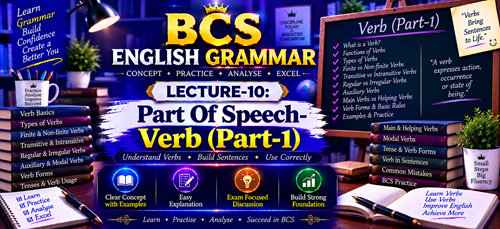
Verb Forms • Finite & Non-finite • Main & Auxiliary • Modal • Transitive & Intransitive • Direct & Indirect Object • Complement • Gerund & Participle
আপলোড করা Master Class-09-এর মূল বিষয় The Verb। PDF-এর BCS question analysis-এ ৪৬তম, ৪১তম ও ১৮তম BCS Preliminary-তে Verb-সংক্রান্ত সরাসরি প্রশ্ন চিহ্নিত করা হয়েছে। বিশেষভাবে Gerund/Passive Gerund, word used as a verb, Modal Auxiliary, Transitive–Intransitive Verb এবং had better + base verb পরীক্ষিত হয়েছে।
| Priority | Topic | BCS/চাকরির পরীক্ষায় Focus |
|---|---|---|
| ★★★ | Transitive & Intransitive Verb | object আছে কি না, rise/raise, lie/lay |
| ★★★ | Gerund & Passive Gerund | avoiding being seen, fear of being arrested |
| ★★★ | Auxiliary & Modal Verb | may, might, must, can, should |
| ★★★ | Verb Patterns | had better + V₁, avoid + V-ing |
| ★★★ | Finite & Non-finite Verb | tense/person/number বনাম infinitive/participle |
| ★★★ | Main vs Auxiliary Verb | be, have, do-এর দ্বৈত ব্যবহার |
| ★★☆ | Direct & Indirect Object | give me a book; give a book to me |
| ★★☆ | Complement | subject/object complement |
| ★★☆ | Basic Forms of Verb | base, past, participle, -ing, infinitive |
| ★★☆ | Linking Verb | be, become, seem, look, taste, feel |
১. Verb — সঠিক সংজ্ঞা
Verb হলো এমন word যা সাধারণত কোনো action, event, state, condition বা experience প্রকাশ করে এবং clause-এর verb phrase-এর কেন্দ্র হিসেবে কাজ করে। যেমন—run, write, happen, know, seem, be, have। Cambridge-এর lexical description-এ verb-কে action, state বা experience প্রকাশকারী word বলা হয়েছে।
PDF-এ Verb-কে sentence-এর essential part হিসেবে গুরুত্ব দেওয়া হয়েছে এবং I am conducting a class উদাহরণের মাধ্যমে verb-এর ভূমিকা দেখানো হয়েছে।
গুরুত্বপূর্ণ সংশোধন: PDF-এর বাংলা সংজ্ঞায় “ব্যক্তি, বস্তু বা স্থান সম্পর্কে বলার জন্য ব্যবহৃত word” বলা হয়েছে; এটি Verb-এর পূর্ণাঙ্গ আধুনিক সংজ্ঞা নয়। BCS-এর জন্য উপরের action/state/event/experience-ভিত্তিক সংজ্ঞাটি বেশি নির্ভুল।
Verb কী কী প্রকাশ করতে পারে?
Action: He runs fast. | State: I know him. | Event: The accident happened yesterday. | Condition: She is ill. | Possession: He has a car. | Experience/Feeling: I love music.
২. Verb — Master Classification
PDF-এর ৫ম পৃষ্ঠার classification diagram-এ Verb-কে Finite ও Non-finite, Finite-এর অধীনে Principal ও Auxiliary, Principal-এর অধীনে Transitive/Intransitive, এবং Non-finite-এর অধীনে Gerund, Infinitive ও Participle হিসেবে সাজানো হয়েছে।
                              VERB
                               │
                ┌──────────────┴──────────────┐
                │                             │
             FINITE                       NON-FINITE
                │                             │
       ┌────────┴────────┐          ┌─────────┼──────────┐
       │                 │          │         │          │
   MAIN/PRINCIPAL    AUXILIARY    INFINITIVE GERUND  PARTICIPLE
       │                 │                             │
 ┌─────┴─────┐      ┌────┴────┐              ┌─────────┼─────────┐
Transitive Intransitive Primary Modal        Present   Past    Perfect
       │
 ┌─────┴────────────┐
Mono-transitive  Di-transitive
তবে modern grammar-এ এই categories একে অপরের সম্পূর্ণ parallel নয়। যেমন finite/non-finite হলো verb-এর grammatical form-এর classification, আর transitive/intransitive হলো verb-এর complementation pattern। একই verb একই সঙ্গে finite + main + transitive হতে পারে।
She bought a book. → bought = finite + main + transitive.
৩. Basic Forms of Verb
PDF-এ Verb-এর ছয়টি classroom form দেওয়া হয়েছে—Base form, Infinitive, Past tense, Past participle, Present participle এবং Gerund। উদাহরণ হিসেবে play, to play, played, eaten, playing, swimming দেখানো হয়েছে।
| Form | Example | Sentence | Function |
|---|---|---|---|
| Base form | play | Children play. | present/base |
| To-infinitive | to play | They want to play. | non-finite |
| Past | played | They played yesterday. | finite past |
| Past participle | eaten | I have eaten. | perfect/passive |
| Present participle | playing | They are playing. | progressive |
| Gerund | swimming | Swimming is useful. | noun-like -ing |
⚠️ Modern Grammar Note
Cambridge main verb-এর five morphological forms চিহ্নিত করে—base, past, past participle, -ing form এবং third-person singular -s form। Gerund ও present participle দেখতে একই -ing form হলেও traditional grammar-এ function অনুযায়ী আলাদা নামে শেখানো হয়।
একটি verb দিয়ে পাঁচটি form
write → writes → wrote → written → writing
go → goes → went → gone → going
eat → eats → ate → eaten → eating
এটি BCS-এর জন্য খুব গুরুত্বপূর্ণ, কারণ irregular verb-এ V₂ ≠ V₃ হতে পারে।
৪. Finite Verb
Finite Verb হলো এমন verb form যা tense বহন করে এবং অনেক ক্ষেত্রে person ও number-এর সঙ্গে grammatical agreement দেখায়। Cambridge-ও finite verb-এর প্রধান বৈশিষ্ট্য হিসেবে tense, person এবং number নির্দেশ করে।
He goes to school. → goes = finite
They went home. → went = finite
She is working. → finite verb phrase = is working; is finite auxiliary।
সহজ Test
Tense/person/number অনুযায়ী form পরিবর্তিত হচ্ছে? → Finite
I work. → He works. → I worked.
৫. Non-finite Verb
Non-finite verb tense, person বা number independently প্রকাশ করে না। Cambridge-এর classification অনুযায়ী infinitive with/without to, -ing forms এবং participial forms non-finite হতে পারে।
I want to go. → to go
Swimming is useful. → swimming
The broken chair was repaired. → broken
NON-FINITE VERB
      │
 ┌────┼──────────┐
 │    │          │
Infinitive    -ing form   Participle
to go/go      going       gone/broken
Golden Rule
Finite → tense/person/number-sensitive
Non-finite → tense/person/number-independent
৬. Gerund বনাম Present Participle
একই V-ing form sentence-এ ভিন্ন কাজ করতে পারে।
Gerund → Noun-like function
Swimming is good exercise.
→ Swimming = subject → Gerund
I enjoy reading.
→ reading = complement of enjoy
Present Participle → Verb/Adjective-like function
The boy is swimming.
→ progressive verb phrase
I saw a crying baby.
→ crying modifies baby
PDF-এ Swimming is the best exercise-এ Swimmingকে Gerund এবং I saw them playing...-এ playingকে Present Participle হিসেবে দেখানো হয়েছে।
৭. Main / Principal Verb
PDF অনুযায়ী যে verb অন্য verb-এর সাহায্য ছাড়াই sentence-এর প্রধান lexical meaning বহন করে তাকে Principal/Main Verb বলা হয়েছে—যেমন call, go, work। Auxiliary-এর পরবর্তী lexical verb-ও main verb হিসেবে কাজ করে।
Rahim works. → works = Main Verb
Rahim is working. → working = Main Verb; is = Auxiliary
We should obey the law. → obey = Main Verb; should = Modal Auxiliary
৮. Main Verb চেনার সহজ পদ্ধতি
PDF-এর rules-কে compact করলে—
একটি মাত্র verb থাকলে সেটিই সাধারণত main verb: He works. | s/es-যুক্ত lexical verb main verb: Nothing lasts forever. | Auxiliary + lexical verb হলে lexical verbটি main verb: We should obey the law.
কিন্তু একটি গুরুত্বপূর্ণ বিষয়—
be, have, do context অনুযায়ী Main অথবা Auxiliary—দুইভাবেই কাজ করতে পারে।
৯. Auxiliary / Helping Verb
Auxiliary Verb main verb-এর সঙ্গে যুক্ত হয়ে tense/aspect, voice, negation, interrogation, emphasis এবং modality প্রকাশে সাহায্য করে।
PDF-এ helping/auxiliary verb-কে Principal Verb-এর Tense, Voice ও Mood গঠনে সহায়ক verb বলা হয়েছে এবং be, have, do-এর পাশাপাশি modal/semi-modal forms দেখানো হয়েছে।
Primary Auxiliaries
| Auxiliary | Forms | প্রধান কাজ |
|---|---|---|
| BE | am, is, are, was, were, be, been, being | progressive + passive |
| HAVE | have, has, had | perfect |
| DO | do, does, did | question, negative, emphasis |
Cambridge-ও English-এর তিনটি primary auxiliary হিসেবে be, do, have চিহ্নিত করে।
১০. BE — Main নাকি Auxiliary?
Main/Linking Verb
He is a doctor.
→ is subject he-কে complement a doctor-এর সঙ্গে link করছে।
Auxiliary
He is reading.
→ is progressive গঠন করছে।
The letter was written.
→ was passive voice গঠন করছে।
Shortcut
be + V-ing → progressive auxiliary
be + V₃ → passive auxiliary
১১. HAVE — Main নাকি Auxiliary?
Main Verb
I have a car.
→ possession; have নিজেই lexical meaning বহন করছে।
Auxiliary
I have finished the work.
→ have + V₃ = perfect construction।
Formula
have/has/had + V₃ → Perfect
১২. DO — Main নাকি Auxiliary?
Main Verb
I did the work.
→ did = performed → main verb।
Auxiliary
Do you know him?
I do not know him.
I do like this book.
Cambridge অনুযায়ী auxiliary do interrogative, negative ও emphatic structure-এ ব্যবহৃত হয়।
১৩. Modal Auxiliary Verb
Core Modal verbs:
can, could, may, might, shall, should, will, would, must
British Council-এর core list-ও এই নয়টি modal দেয়। এগুলো possibility, certainty, necessity, ability, permission, request ইত্যাদি modality প্রকাশ করে।
| Modal | Common Meaning |
|---|---|
| can | ability/permission |
| could | past ability/polite possibility |
| may | permission/possibility |
| might | weaker possibility |
| shall | future/offer/suggestion |
| should | advice/expectation |
| will | prediction/willingness |
| would | conditional/polite/habit |
| must | strong obligation/deduction |
🔥 Master Rule
Modal + Base Form (V₁)
can go | should study | must obey | might come
❌ can goes
❌ should studied
১৪. Semi-modals / Marginal Modals
PDF-এর তালিকায় need, dare, used to, ought to-কেও modal group-এর সঙ্গে রাখা হয়েছে। Modern descriptions-এ এগুলোকে অনেক সময় semi-modal/marginal modal বলা হয়; Cambridge-ও dare, need, ought to, used to-কে semi-modal হিসেবে আলাদা করে।
১৫. 🔥 ৪৬তম BCS — Modal Auxiliary
I didn’t follow who passed by me. It ____ Shajib.
ক. were
খ. must be
গ. might be
ঘ. was
✅ PDF-এর উত্তর: might be
ব্যাখ্যা: Speaker নিশ্চিত নয়; অনুমান/possibility প্রকাশ করছে। তাই might + base form be উপযুক্ত। PDF-এর ১৬ নম্বর পৃষ্ঠায় প্রশ্নটি modal auxiliary হিসেবে চিহ্নিত করা হয়েছে।
must be হলে তুলনামূলক শক্তিশালী logical deduction বোঝাত।
১৬. Transitive Verb
যে verb কোনো direct object গ্রহণ করে তাকে Transitive Verb বলে।
Pattern
Subject + Transitive Verb + Direct Object
I like tea.
She opened the door.
Mother loves me.
PDF-এ Transitive Verb-এর ক্ষেত্রে direct object প্রয়োজন বলে like it/him, avoid it/him, start it, stop it, enjoy it উদাহরণ দেওয়া হয়েছে। Cambridge-ও transitive verb-কে object গ্রহণকারী verb হিসেবে সংজ্ঞায়িত করে।
Object বের করার Test
Verb + what/whom?
She bought a book.
Bought what? → a book → Direct Object → bought transitive।
১৭. সম্ভাব্য প্রশ্ন
Mother loves me. Here ‘loves’ is an example of—
ক. Transitive verb
খ. Auxiliary verb
গ. Simple verb
ঘ. Intransitive verb
✅ উত্তর: Transitive Verb
কারণ loves whom? → me; me direct object।
১৮. Intransitive Verb
যে verb direct object গ্রহণ করে না তাকে Intransitive Verb বলে।
Pattern
Subject + Intransitive Verb (+ Adverbial)
The baby cried.
He came here.
They arrived yesterday.
PDF-এ Come here, Go there উদাহরণ দিয়ে intransitive verb বোঝানো হয়েছে এবং riseকে intransitive হিসেবে চিহ্নিত করা হয়েছে। Cambridge-এর common intransitives-এর মধ্যে arrive, come, fall, happen, rise, die, appear ইত্যাদি রয়েছে।
১৯. ⚠️ Transitive Rule-এর গুরুত্বপূর্ণ সংশোধন
PDF-এ সহজ shortcut হিসেবে বলা হয়েছে—verb-এর পরে noun/pronoun থাকলে verb transitive এবং verb-এর পরে adverb/preposition থাকলে intransitive। পরীক্ষার basic question-এ এটি কাজে লাগতে পারে, কিন্তু এটি universal rule নয়।
কারণ—
He became a doctor.
→ a doctor noun phrase হলেও এটি object নয়; subject complement।
She looked at me.
→ me আছে, কিন্তু এটি preposition at-এর object; look direct object নেয়নি।
অতএব সঠিক test হলো:
Verb সরাসরি Direct Object গ্রহণ করেছে কি না?
২০. একই Verb Transitive এবং Intransitive—দুইভাবেই হতে পারে
এটি PDF-এর basic shortcut-এর বাইরে খুব গুরুত্বপূর্ণ modern concept। Cambridge এবং British Council দুটিই দেখায় যে অনেক verb context অনুযায়ী উভয়ভাবে ব্যবহৃত হয়।
| Transitive | Intransitive |
|---|---|
| He opened the door. | The door opened. |
| She boiled the water. | The water boiled. |
| He runs a company. | He runs every morning. |
| I eat rice. | I have already eaten. |
| She sings songs. | She sings beautifully. |
🎯 BCS Strategy
কেবল dictionary meaning দেখে নয়—sentence-এ verb-এর actual use দেখে transitivity নির্ধারণ করবে।
২১. 🔥 ৪১তম BCS — Intransitive Verb
“Huffing and puffing, we arrived at the classroom door with only seven seconds to spare.” In this sentence ‘arrived’ is—
ক. intransitive
খ. transitive
গ. causative
ঘ. defective
✅ সঠিক উত্তর: Intransitive
কারণ arrive কোনো direct object নেয়নি। at the classroom door হলো prepositional phrase/adverbial; door সরাসরি arrived-এর object নয়। প্রশ্নটি PDF-এ ৪১তম BCS হিসেবে দেওয়া হয়েছে।
Cambridge-ও arrive-কে commonly intransitive verb-এর তালিকায় রাখে।
২২. Rise বনাম Raise — ★★★
PDF-এ পরীক্ষার জন্য গুরুত্বপূর্ণ pair:
rise = intransitive
raise = transitive
| Verb | Meaning | Pattern | Forms |
|---|---|---|---|
| rise | ওঠা | no object | rise–rose–risen |
| raise | তোলা | takes object | raise–raised–raised |
The sun rises.
Prices rose.
কিন্তু—
They raised the price.
Raise your hand.
Memory Trick
Something RISES itself; someone RAISES something.
২৩. Lie বনাম Lay — ★★★
PDF-এর handwritten explanation-এ lie intransitive এবং lay transitive হিসেবে আলাদা করা হয়েছে।
| Meaning | Present | Past | Past Participle |
|---|---|---|---|
| শোয়া | lie | lay | lain |
| রাখা | lay | laid | laid |
| মিথ্যা বলা | lie | lied | lied |
He lies on the bed. → no object
He lay on the bed yesterday.
কিন্তু—
He lays the book on the table.
→ lays what? → the book
🔥 Trap
lay একই সঙ্গে lie-এর past এবং আলাদা transitive verb-এর present form হতে পারে।
২৪. Sit বনাম Set
Traditional exam pair:
sit = generally intransitive
set = often transitive
Please sit here.
She set the vase on the table.
তবে modern English-এ set বিভিন্ন construction-এ ব্যবহৃত হয়; তাই actual sentence pattern দেখাই safest।
২৫. Direct Object
Direct Object হলো সেই noun phrase/pronoun যার ওপর transitive verb-এর action সরাসরি পড়ে বা যা verb-এর complementation পূরণ করে।
He was reading a book.
→ reading what? → a book
He likes me.
→ likes whom? → me
PDF-এও একমাত্র object থাকলে সেটিকে direct object হিসেবে দেখানো হয়েছে।
২৬. Indirect Object
Indirect Object সাধারণত action-এর recipient বা beneficiary—কাকে/কার জন্য কিছু দেওয়া, পাঠানো, বানানো ইত্যাদি হচ্ছে তা নির্দেশ করে।
She gave me a book.
me → Indirect Object
a book → Direct Object
PDF-এর rule অনুযায়ী—
to/for whom? → Indirect Object
what? → Direct Object
২৭. Direct–Indirect Object Diagram
             She gave me a book.
                  │
          ┌───────┼────────┐
          │       │        │
       Subject   Verb    Objects
                           │
                    ┌──────┴──────┐
                    │             │
                  me          a book
                   │              │
             INDIRECT         DIRECT
              OBJECT           OBJECT
             (to whom?)        (what?)
২৮. Double Object Pattern
PDF-এর ১৩ নম্বর পৃষ্ঠায় দুটি গুরুত্বপূর্ণ structure দেওয়া হয়েছে।
Pattern–1
S + V + IO + DO
He gave me a book.
She sent her mother a letter.
এখানে IO ও DO-এর মাঝে preposition নেই।
Pattern–2
S + V + DO + to/for + Recipient/Beneficiary
He gave a book to me.
She bought a gift for me.
২৯. TO বনাম FOR
TO → transfer/direction
give, send, show, lend, offer, write
She sent the letter to me.
FOR → benefit/purpose
buy, make, cook, get, find
She bought a gift for me.
Memory
TO → কাকে পৌঁছাল?
FOR → কার জন্য করা হলো?
৩০. ⚠️ সব Verb Double-object Pattern নেয় না
❌ He explained me the rule.
✅ He explained the rule to me.
❌ She described me the situation.
✅ She described the situation to me.
অতএব S + V + IO + DO সব transitive verb-এর ক্ষেত্রে ব্যবহার করা যায় না; verb-এর নিজস্ব complementation pattern জানতে হয়।
৩১. Complement
PDF অনুযায়ী verb-এর পরের noun/adjective যদি subject বা object-কে identify, rename বা describe করে এবং একই entity-কে নির্দেশ করে, সেটি Complement। Examples: He became a doctor; He became angry; He is a fool; Honey tastes sweet.
Subject Complement
He is a doctor.
He = a doctor
Honey tastes sweet.
Honey = sweet (description)
Object Complement
They elected him president.
him = object
president = object complement
৩২. Object বনাম Complement
| Object | Complement |
|---|---|
| সাধারণত noun phrase/pronoun | noun phrase/adjective phrase হতে পারে |
| action-এর participant | subject/object-কে identify/describe করে |
| He helped me. | He became angry. |
| I love you. | He is a doctor. |
PDF-এও Object ও Complement-এর এই মূল distinction দেওয়া হয়েছে।
৩৩. Linking Verb
Linking Verb action object-এর দিকে transfer না করে subject-কে subject complement-এর সঙ্গে যুক্ত করে।
Common linking verbs:
be, become, seem, appear, look, feel, smell, taste, sound, remain, grow, turn
She looks happy.
The soup tastes delicious.
He became a teacher.
British Council linking verb-এর basic patterns হিসেবে N + V + Adjective এবং N + V + N দেখায়।
৩৪. Linking Verb বনাম Action Verb
একই verb context অনুযায়ী function বদলাতে পারে।
She looked happy.
→ looked = linking; happy = complement
She looked at me.
→ looked = action/intransitive use; at me = prepositional complement/adverbial
The soup tastes good.
→ linking
He tasted the soup.
→ transitive action verb; the soup = object
৩৫. Mono-transitive, Di-transitive ও Complex-transitive
PDF-এর classification diagram-এ Transitive Verb-এর অধীনে Mono-transitive, Di-transitive এবং Linking Verb-সংক্রান্ত branch দেখানো হয়েছে। আরও নির্ভুল modern pattern:
Monotransitive
S + V + DO
She bought a book.
Ditransitive
S + V + IO + DO
She gave me a book.
Complex-transitive
S + V + DO + Object Complement
They elected him president.
এটি object/complement অধ্যায়ের সঙ্গে সরাসরি সম্পর্কিত এবং advanced MCQ-তে কাজে লাগে।
৩৬. 🔥 ৪৬তম BCS — Passive Gerund
In fear of _____ he escaped elsewhere.
ক. arresting
খ. arrested
গ. being arrested
ঘ. having arrested
✅ সঠিক উত্তর: being arrested
PDF-এ এটি ৪৬তম BCS-এর প্রশ্ন হিসেবে দেওয়া হয়েছে।
কেন?
of = preposition → এর পরে noun/gerundial expression দরকার। ব্যক্তি নিজে arrest করছে না; তাকে arrest করা হবে → passive meaning।
Formula
Preposition + being + V₃ = Passive Gerund Construction
fear of being arrested
without being noticed
after being selected
৩৭. 🔥 ৪৬তম BCS — Avoid + Passive Gerund
The submarine dipped to avoid ____ by the enemy plane.
ক. see
খ. seeing
গ. being seen
ঘ. seen
✅ সঠিক উত্তর: being seen
কারণ avoid + V-ing, এবং submarine দেখছে না—enemy plane দ্বারা seen হচ্ছে; তাই passive প্রয়োজন।
avoid + being + V₃
PDF-এ প্রশ্নটি ৪৬তম BCS হিসেবে দেওয়া হয়েছে। British Council-ও enjoy, admit, mind ইত্যাদি verb-এর পরে -ing form এবং verb-dependent gerund/infinitive pattern-এর গুরুত্ব দেখায়।
৩৮. Gerund Pattern — High Yield
কিছু verb-এর পরে সাধারণত V-ing লাগে:
avoid, enjoy, admit, mind, finish, practise, suggest, consider, deny, risk, keep
He avoided meeting me.
She enjoys reading.
He admitted stealing the money.
Passive দরকার হলে
avoid being caught
dislike being ignored
remember being praised
৩৯. Infinitive Pattern
অনেক verb-এর পরে to + V₁ লাগে:
want, decide, hope, plan, agree, refuse, promise, expect, learn
I want to go.
She decided to stay.
British Council-ও plan to take, decide to stay ইত্যাদি verb + to-infinitive pattern দেখায়।
৪০. Bare Infinitive
কিছু structure-এ to ছাড়া V₁ লাগে:
Modal + V₁
→ can go, must study
had better + V₁
→ had better leave
would rather + V₁
→ would rather stay
let + object + V₁
→ Let me go.
make + object + V₁
→ They made him work.
British Council-ও make ও let-এর পরে bare infinitive pattern দেখায়।
৪১. 🔥 ১৮তম BCS — Had Better
Travellers ____ their reservations well in advance if they want to fly during the Eid holidays.
ক. had better to get
খ. had to get better
গ. had better get
ঘ. had better got
✅ সঠিক উত্তর: had better get
PDF-এ এটি ১৮তম BCS-এর প্রশ্ন।
Golden Formula
had better + V₁
You had better go now.
We had better study hard.
❌ had better to go
❌ had better went
৪২. 🔥 ৪৬তম BCS — Word Used as a Verb
Which of the following words can be used as a verb?
ক. mobile
খ. sugar
গ. media
ঘ. sand
✅ PDF-এর উত্তর: sand
প্রশ্নটি ৪৬তম BCS হিসেবে দেওয়া হয়েছে।
sand verb হিসেবে surface-কে sand/sandpaper দিয়ে ঘষা বা বালি প্রয়োগ করা অর্থে ব্যবহৃত হতে পারে।
গুরুত্বপূর্ণ Concept: Conversion / Zero Derivation
English-এ একই word কোনো suffix পরিবর্তন ছাড়াই noun → verb হতে পারে:
water the plants
email me
bottle the milk
hammer the metal
Google something
sand the wood
অতএব part of speech নির্ধারণে শুধু word নয়, sentence-এর function দেখতে হবে।
৪৩. Action Verb বনাম Stative Verb
PDF-এর classification chart-এ Action Verb ও State Verb-এর distinction দেখানো হয়েছে।
Action/Dynamic Verb
কাজ/প্রক্রিয়া:
run, write, eat, build, play, work
Stative Verb
state, possession, cognition, emotion:
know, believe, understand, love, own, belong, seem
Common Exam Rule
Stative verb সাধারণত progressive-এ কম ব্যবহৃত হয়:
✅ I know him.
❌ I am knowing him.
✅ I understand the problem.
❌ I am understanding the problem.
তবে context বদলালে কিছু stative verb dynamic হতে পারে:
I think he is right. → opinion/state
I am thinking about the problem. → mental activity
৪৪. Regular বনাম Irregular Verb
Regular Verb
Past ও Past Participle সাধারণত -ed/-d:
work–worked–worked
play–played–played
Irregular Verb
নিজস্ব form:
go–went–gone
write–wrote–written
eat–ate–eaten
see–saw–seen
take–took–taken
BCS Trap
V₂ এবং V₃ এক নয়—বিশেষত passive/perfect construction-এ ভুল হয়।
He has went ❌
He has gone ✅
The letter was wrote ❌
The letter was written ✅
৪৫. Auxiliary Formula Chart
                    AUXILIARY SYSTEM
                          │
        ┌─────────────────┼─────────────────┐
        │                 │                 │
        BE               HAVE              DO
        │                 │                 │
  be + V-ing          have + V₃        do + V₁
  Progressive          Perfect       Question/Negative
        │
     be + V₃
      Passive
Examples
She is reading. → BE + V-ing
She has written. → HAVE + V₃
She was praised. → BE + V₃
Does she know? → DO + V₁
৪৬. Verb Pattern Master Chart
| Pattern | Example | Function |
|---|---|---|
| S + V | Birds fly. | Intransitive |
| S + V + O | I read books. | Monotransitive |
| S + V + IO + DO | She gave me a pen. | Ditransitive |
| S + V + C | He became angry. | Linking |
| S + V + O + C | They elected him captain. | Complex transitive |
| Modal + V₁ | He can swim. | Modal |
| have + V₃ | He has gone. | Perfect |
| be + V-ing | He is working. | Progressive |
| be + V₃ | He was arrested. | Passive |
| Verb + to-infinitive | I want to leave. | Non-finite complement |
| Verb + gerund | I enjoy reading. | -ing complement |
British Council-এর clause-pattern description-এ subject + verb-এর সঙ্গে object, complement ও adverbial—এই বিভিন্ন structure এবং transitive/intransitive, linking, double-object patterns একইভাবে আলাদা করা হয়েছে।
৪৭. Object, Complement ও Adverbial — Confusion Killer
Object
I bought a book.
→ a book = object
Complement
He became a doctor.
→ a doctor = subject complement
Adverbial
He arrived at school.
→ at school = place adverbial/prepositional phrase
এজন্য—
He arrived at school.
school noun হলেও arrived transitive নয়; কারণ school সরাসরি verb-এর object নয়।
৪৮. “What/Whom Test” — কাজে লাগে, কিন্তু সাবধানে
She killed the snake.
Killed what? → snake → Object.
কিন্তু—
He became a doctor.
“became what?” বললে doctor পাওয়া গেলেও এটি object নয়; কারণ He = doctor। তাই identity relation থাকলে complement হতে পারে।
Best Test
Verb-এর পরে Noun/Pronoun আছে
           │
           ▼
Verb সরাসরি action গ্রহণকারী entity?
     ┌─────┴─────┐
    YES          NO
     │            │
  OBJECT      Subject-কে
              identify/describe?
                    │
                   YES
                    │
               COMPLEMENT
৪৯. 🔥 BCS Direct Question Master Table
| BCS | Question Focus | Correct Answer | Core Rule |
|---|---|---|---|
| ৪৬তম | in fear of ___ | being arrested | prep + passive gerund |
| ৪৬তম | word used as verb | sand | conversion |
| ৪৬তম | avoid ___ by enemy | being seen | avoid + passive -ing |
| ৪৬তম | It ___ Shajib | might be | modal possibility |
| ৪১তম | arrived | intransitive | no direct object |
| ১৮তম | Travellers ___ reservations | had better get | had better + V₁ |
এই প্রশ্নগুলো PDF-এর ১৫–১৬ নম্বর পৃষ্ঠায় একত্রে দেওয়া হয়েছে।
৫০. ★★★ BCS High-Yield Pair List
| Intransitive | Transitive | Example |
|---|---|---|
| rise | raise | Prices rise / Raise prices |
| lie | lay | Lie down / Lay the book |
| sit | seat/set | Sit here / Seat the guest |
| fall | fell | Tree fell / Fell a tree |
এর মধ্যে rise/raise এবং lie/lay সবচেয়ে বেশি গুরুত্বপূর্ণ।
৫১. Common Verb-Pattern Errors
| ❌ Wrong | ✅ Correct | Rule |
|---|---|---|
| He can goes. | He can go. | modal + V₁ |
| You had better to leave. | You had better leave. | had better + V₁ |
| He avoided to meet me. | He avoided meeting me. | avoid + -ing |
| He enjoys to read. | He enjoys reading. | enjoy + -ing |
| I want going. | I want to go. | want + infinitive |
| He has went. | He has gone. | have + V₃ |
| The letter was wrote. | The letter was written. | passive = be + V₃ |
| He raised early. | He rose early. | rise = intransitive |
| He laid on bed. | He lay on the bed. | lie–lay–lain |
৫২. Gerund–Participle–Infinitive Quick Comparison
| Form | Typical Function | Example |
|---|---|---|
| Gerund | noun-like | Reading helps us. |
| Present Participle | progressive/modifier | He is reading. |
| Past Participle | perfect/passive/modifier | a broken chair |
| Infinitive | non-finite complement/purpose | I want to read. |
Cambridge-এর finite/non-finite analysis অনুযায়ী infinitives, -ing forms এবং participial forms tense/person/number independently প্রকাশ করে না।
৫৩. 🧠 Verb Identification Flowchart
                     VERB পেয়েছেন
                          │
                          ▼
              Tense/person/number আছে?
                   ┌──────┴──────┐
                  YES            NO
                   │              │
                FINITE        NON-FINITE
                   │              │
          Main meaning?       ┌───┼────┐
           ┌────┴────┐        │   │    │
          YES        NO     Gerund Inf. Participle
           │          │
        MAIN      AUXILIARY
           │          │
   Direct object?   Primary/Modal
      ┌────┴────┐
     YES        NO
      │          │
TRANSITIVE   INTRANSITIVE/
             LINKING
৫৪. ⚠️ সবচেয়ে গুরুত্বপূর্ণ Conceptual Trap
Finite/Non-finite, Main/Auxiliary এবং Transitive/Intransitive একই level-এর classification নয়।
উদাহরণ:
She has written a letter.
has → finite + auxiliary
written → non-finite participial form + main lexical verb
write → এখানে transitive use, কারণ a letter direct object।
অর্থাৎ একটি verb-কে একাধিক grammatical dimension দিয়ে classify করা যায়।
৫৫. Verb Phrase Analysis — BCS Advanced Skill
He may have been working.
He | may | have | been | working
     │      │      │       │
   Modal  Perfect   BE    Main Verb
                   Progressive
The letter may have been written.
may + have + been + written
 │      │      │        │
Modal Perfect Passive   Main lexical verb
এই ধরনের structure বোঝা গেলে Tense, Voice, Modal ও Verb—চার অধ্যায়ের প্রশ্ন একসঙ্গে সহজ হয়।
৫৬. 🧠 এক নজরে Complete Verb Map
THE VERB
│
├── FORM
│   ├── Base → go
│   ├── -s → goes
│   ├── Past → went
│   ├── Past Participle → gone
│   └── -ing → going
│
├── FINITENESS
│   ├── Finite → goes/went/is
│   └── Non-finite
│       ├── Infinitive
│       ├── Gerund/-ing
│       └── Participle
│
├── FUNCTION
│   ├── Main/Lexical
│   └── Auxiliary
│       ├── Primary → be/have/do
│       └── Modal → can/may/must...
│
└── COMPLEMENTATION
    ├── Intransitive → S + V
    ├── Transitive → S + V + O
    ├── Ditransitive → S + V + IO + DO
    ├── Complex-transitive → S + V + O + C
    └── Linking → S + V + C
৫৭. 🎯 BCS Exam Strategy
Verb-এর প্রশ্নে প্রথমে verb form দেখবে—V₁/V₂/V₃/V-ing/to-infinitive; এরপর auxiliary/modal আছে কি না দেখবে; তারপর direct object আছে কি না দেখে transitive/intransitive নির্ধারণ করবে; শেষে object নাকি complement যাচাই করবে। Gerund/infinitive question-এ preceding verb বা preposition-এর pattern খুঁজবে এবং active/passive meaning বিচার করবে।
বিশেষ করে এই formulaগুলো মুখস্থ রাখবে:
Modal + V₁ | Had better + V₁ | Have + V₃ | Be + V-ing | Passive = Be + V₃ | Avoid + V-ing | Preposition + V-ing | Passive Gerund = being + V₃ | Rise–Rose–Risen | Raise–Raised–Raised | Lie–Lay–Lain | Lay–Laid–Laid
৫৮. 🚀 BCS Last-Minute Super Capsule
Verb = action/state/event/experience প্রকাশকারী clause-centred word ⇒ Verb-এর form বুঝতে base, -s, past, past participle, -ing জানতে হবে ⇒ Finite tense/person/number বহন করে; Non-finite independently করে না ⇒ Non-finite-এর গুরুত্বপূর্ণ forms infinitive, -ing/gerund, participle।
Main Verb lexical meaning বহন করে ⇒ Auxiliary = be, have, do + modals ⇒ be + V-ing = progressive | be + V₃ = passive | have + V₃ = perfect | modal + V₁। be/have/do context অনুযায়ী Main বা Auxiliary—দুইটিই হতে পারে।
Transitive = direct object নেয় | Intransitive = direct object নেয় না ⇒ কিন্তু শুধু verb-এর পর noun দেখেই সিদ্ধান্ত নয়; nounটি সত্যিই direct object কি না দেখতে হবে ⇒ arrive at school-এ school preposition-এর object, তাই arrive intransitive ⇒ একই verb context অনুযায়ী transitive/intransitive উভয় হতে পারে—open the door / the door opened।
Direct Object = what/whom | Indirect Object = recipient/beneficiary ⇒ give me a book = IO + DO ⇒ give a book to me ⇒ Complement subject/object-কে identify বা describe করে—He became a doctor; Honey tastes sweet। PDF-এ Direct/Indirect Object ও Complement-এর এই distinctions বিস্তারিতভাবে দেওয়া হয়েছে।
সবশেষে ৬টি BCS-tested point একসঙ্গে মনে রাখুন—৪৬তম: being arrested, sand, being seen, might be; ৪১তম: arrived = intransitive; ১৮তম: had better get।
The Verb-এর সবচেয়ে কার্যকর Master Formula:
FORM → FINITE/NON-FINITE → MAIN/AUXILIARY → OBJECT → COMPLEMENT → VERB PATTERN
এই lecture সম্পর্কে আপনার মতামত
Login করার প্রয়োজন নেই। আপনার review আগে admin দেখে approve করলে সবার জন্য প্রকাশিত হবে।